There’s a moment every chess-playing parent knows well: the first time their five-year-old sits still for twenty straight minutes, chin in hand, staring at a board, refusing to move until they’ve “found the best one.” A board, thirty-two pieces, and a puzzle did that.
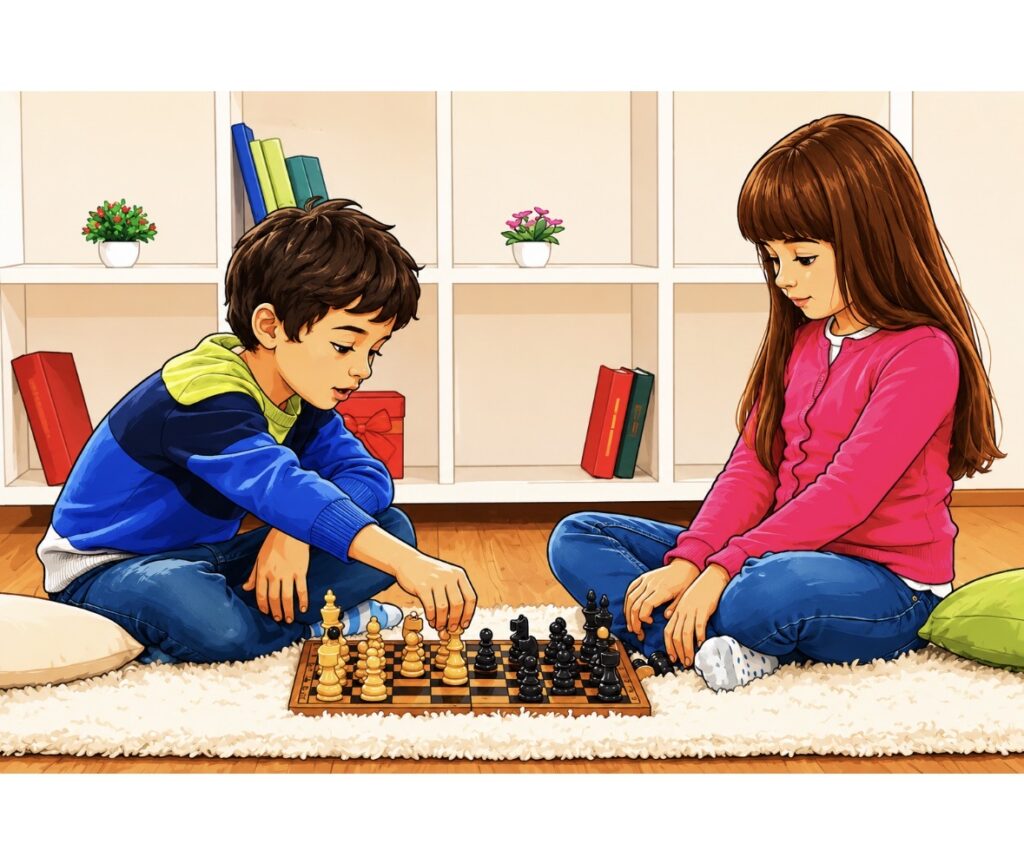
That moment is not an accident. It’s backed by a growing body of research, decades of classroom pilots, and the testimony of some of the most accomplished minds the game has ever produced, and it’s why chess is quietly becoming one of the most talked-about tools in early childhood development.
How Do Grandmasters ‘See’ Moves Before They Happen? Science Finally Knows
Judit Polgar, the strongest female chess player in history and the youngest Grandmaster ever at the time of her title, has spent the years since her retirement building chess curricula for elementary schools across Hungary and beyond. Her assessment is blunt: chess is one of the most powerful tools available for sharpening how children think.
That’s not just a champion’s pride talking. A 2025 study published in Frontiers in Psychology ran pre- and post-tests on young children before and after structured chess instruction, comparing them against a control group. The results were statistically significant: measurable gains in attention, memory, logical reasoning, patience, self-discipline, and — notably — math and reading scores. The researchers pointed to something simple underneath it all: chess forces a child to reason, plan spatially, and think several steps ahead, and those same muscles get flexed in the classroom.
Other research backs this up from a different angle. Studies referenced by child-development researchers have found that after just 10 to 12 weeks of chess training, children showed longer attention spans, more thoughtful decision-making, and — in children with ADHD specifically — reduced impulsivity compared to non-players. Neuroscience research out of the University of Memphis has shown that a game of chess doesn’t just light up the brain’s planning centers; it also activates areas tied to visual recognition, spatial memory, and emotional regulation, essentially giving a young brain a full-body workout in a single sitting.
To be fair, not every researcher agrees on how far the benefits travel. A widely cited meta-analysis in Contemporary Educational Psychology found real gains from chess instruction but urged caution about assuming those gains transfer automatically to every academic subject, noting more rigorous study is still needed. It’s a fair caveat — but even the skeptics agree chess reliably builds the child’s own thinking skills within the game itself, and most parents will tell you that’s plenty of reason to hand a five-year-old a rook.
Chess Doesn’t Just Build Better Players. It Builds Better Thinkers
Strip away the academic language and the benefits get very relatable, very fast:
They learn to lose — and get back up. Chess is one of the few activities where a five-year-old experiences pure, unassisted consequence: no teammate to blame, no excuse to hide behind. Every loss is 100% theirs to sit with, and every rematch is a lesson in resilience most adults are still learning.
They learn to think before they act. In a world of instant answers and swipe-away attention spans, chess is deliberately slow. It teaches a child to pause, consider consequences, and choose — a skill that shows up years later in how they handle an exam, a conflict with a sibling, or a tough conversation with a friend.
They learn patience without being told to “be patient.” Nobody enjoys hearing “calm down” from a parent. But a chess clock, a stubborn opponent, and a position that won’t resolve itself teach patience far more effectively than any lecture.
They build real confidence. Not the empty, everyone-gets-a-trophy kind — the kind that comes from solving something hard, entirely on their own, and knowing they earned it.
It’s Not Just Good for the Child — It’s Good for the Parent, Too
A chessboard is one of the last remaining places where a parent and a five-year-old sit across from each other, make eye contact, and take turns without a notification interrupting either of them. Researchers who study parent-child interaction have long pointed to the quality of shared, focused time as a major driver of a child’s emotional development — and a 20-minute game does more of that in one sitting than most families manage in a week of “quality time” squeezed between errands.
It also buys parents something priceless: a child who is learning to entertain their own mind. A child who can sit with a chess puzzle for twenty minutes is a child who is building the same independent focus they’ll need for homework, for reading, for every long, unglamorous task adulthood is going to hand them.
Age Five Isn’t Too Young — It Might Be the Ideal Age
Skeptical parents often ask: isn’t five a little young? The research — and the results — suggest the opposite. Younger children’s cognitive and academic skills are still forming, which is exactly why early chess intervention tends to produce more transfer into other areas of learning than starting at ten or twelve, once habits of mind are more fixed.
Laszlo Polgar, the Hungarian educational psychologist who trained all three of his daughters — Judit, Susan, and Sofia — into world-class chess players from early childhood, built his entire philosophy on one conviction: genius isn’t born, it’s built, and it’s built early.
You don’t need to raise a Grandmaster. You need thirty minutes a week and a willingness to lose to your own five-year-old — repeatedly, and with a smile.
Chess won’t replace reading time, sports, or free play — and it doesn’t need to. What it offers is something none of those quite replicate on their own: a quiet, structured space where a young child learns to think for themselves, sit with discomfort, and grow a little sharper, one game at a time. The children who start young rarely remember learning the rules. They just grow up as people who think a few moves ahead — in chess, and in everything else.
P.S. — If you’re ready to give your child this head start, Boss Chess Academy runs live weekly chess sessions for kids over Zoom, where your child gets to learn and play against peers from all across the world — right from home. To sign up, contact 08075608147. We also organise programming and design sessions for kids.